Leslie Boonekamp
Born in Mount Gambier, South Australia, 1953
Resides and works in Altona Meadows, Melbourne, Victoria, Australia
EDUCATION & TRAINING
1969–1973 Fine Art, Stadsakademie, Maastricht, the Netherlands
2009 Bachelor of Arts (Art), Curtin University of Technology, Perth, Western Australia (abbreviated based on prior professional experience)
2013 Postgraduate Certificate, Ancient History (including Museum Curatorship studies), Macquarie University, Sydney, New South Wales
2017 Master of Teaching English to Speakers of Other Languages (TESOL), Charles Sturt University, Australia
SELECTED SOLO EXHIBITIONS
1981 Galerie Orangerie, Cologne, Germany
1982 Galerie Brenner, Aachen, Germany
1983 Studio Rongen, Mechelen, Limburg, the Netherlands
2003 New Works, Thierry B Contemporary Art Gallery, Melbourne, Australia (14–31 October)
2004 Clay Versus Paint, Gallery NewQuay, Docklands, Melbourne, Australia (22 April–16 May)
SELECTED GROUP EXHIBITIONS
2004 Group Exhibition, Gallery NewQuay, Docklands, Melbourne, Australia (July)
2014 Group Exhibition, Beth Hulme Gallery, Fitzroy North, Melbourne, Australia
2015 Group Exhibition, Beth Hulme Gallery, Fitzroy North, Melbourne, Australia
SELECTED ENTRY
2022 Victorian Sculpture Prize, Ontogenesis (selected), Melbourne, Australia
PROFESSIONAL CONTRIBUTIONS
1998–2003 Director, Boonekamp Studio Productions — large-scale commissions for the commercial and hospitality sector, Victoria and nationally. Notable commissions include Melbourne Central Mural, Royal Melbourne Zoo, and Stokehouse, St Kilda.
PRESS & PUBLICATIONS
c. 2002–03 Boonekamp Studio commissioned work featured in Specifier: Architectural Interior, Issue 40 (cover feature)
c. 2002–03 Australian Design Trends, Volume 17, No. 8
c. 2002–03 Indesign, Issue 06, p. 110
c. 2002–03 Brush Out: Wattyl Magazine for Interior and Exterior Coating Solutions, Issue 5
2003 Variety: The Children's Charity, 18 September 2003
1970s Australian Galleries, Derby Street, Collingwood, Melbourne, Australia
1980s Gould Gallery, South Yarra, Melbourne, Australia
2003 Thierry B Contemporary Art Gallery, South Yarra, Melbourne, Australia
COLLECTIONS
Private collection, Japan (acquired via Gould Gallery, South Yarra, Melbourne, 1980s)
Private collection, Australia (acquired via Australian Galleries, Melbourne, 1970s)
Private collections, the Netherlands, Germany, and Belgium
Private collections, Australia
CONTACT
Leslie Boonekamp
Altona Meadows, Melbourne, Victoria, Australia
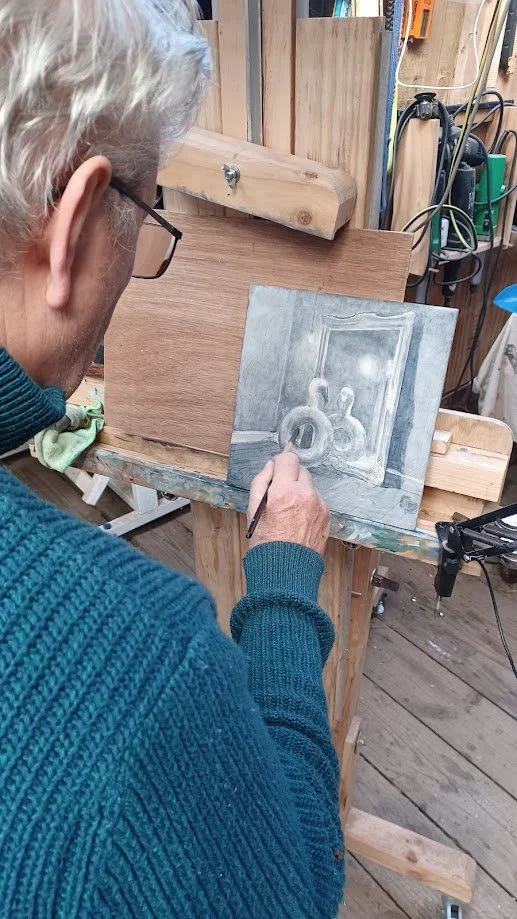
Leslie Boonekamp was born in 1953 in Mount Gambier, South Australia, and lives and works in Melbourne, Australia. He works in oils on marine ply, building luminosity through multiple transparent glazing layers over monochrome underpainting — a method derived from egg tempera and the Flemish masters. He is best known for paintings that place everyday inflatable objects in situations of radical philosophical incongruity, and for elegiac works exploring human displacement, migration, and loss through the language of abandoned childhood objects.
His practice centres on two bodies of work. The Absurdist Series confronts the indifference of the universe with wit rather than despair — swim rings in Antarctic seas, boys in paper boats on wild oceans, rubber ducks as sightseers at the end of the world. The Displacement Series is quieter, working through objects of childhood adrift in open water to address loss, migration, and the fragility of human circumstance.
Boonekamp trained at the Stads Akademie, Maastricht, and subsequently at Curtin University, Western Australia. He spent two decades as a self-employed site-specific artist working in sculpture and large-scale murals across Australia, Belgium, the Netherlands, and Germany before returning to painting.
I came back to painting the way you return to a language you thought you'd forgotten — haltingly at first, then with sudden fluency, then wondering why you ever stopped.
After two decades as a site-specific artist working in sculpture and murals, I retired and found myself at a blank panel with a brush and no brief to fulfil. What emerged was the work I had always meant to make.
My practice centres on two bodies of work. The Absurdist Series places inflatable objects — flamingo swim rings, rubber ducks, paper boats — in situations of radical incongruity. A swim ring navigating Antarctic seas. A boy in a paper boat on a wild and indifferent ocean. These are not jokes. They are propositions about resilience, about the absurd courage required simply to exist, about the philosophical position that the universe's indifference is not a tragedy but a condition to be met with equal indifference and, if possible, wit. Camus would recognise the territory. Magritte would recognise the method. Beckett would recognise the persistence.
The Displacement Series is quieter and more elegiac — objects of childhood adrift in waters that speak of loss, migration, and the fragility of the lives we build. A child's life jacket. A submerged toy. A paper boat travelling alone, its passenger's fate permanently unresolved. Drawing on Baudrillard's theory of the simulacrum and the Japanese concept of mono no aware — the bittersweet awareness that all things pass — these works address the universal experience of displacement and cultural dislocation.
Technically, I work from monochrome underpainting upward through multiple transparent glazing layers — a method derived from egg tempera and the Flemish masters — building luminosity from within rather than applying it from without. I work on marine ply panels with very fine brushes. The light in my paintings is not reflected. It is generated.
My credo is simple: it is about what you paint and how you paint. The image should be so dominant that the technique becomes invisible.
Original oil paintings and archival giclée prints on Hahnemühle German Etching 310gsm are available through this website and through selected online galleries internationally, with worldwide shipping.
Born in Mount Gambier, South Australia. Trained at the Stads Akademie, Maastricht. Lives and works in Melbourne, Australia.
PRESS & MEDIA
c. 2002–03 Wayne Finschi Concept Design in Specifier: Architectural Interior, Issue 40 (cover feature)
c. 2002–03 Australian Design Trends, Volume 17, No. 8
c. 2002–03 Indesign, Issue 06, p. 110
c. 2002–03 Brush Out: Wattyl Magazine for Interior and Exterior Coating Solutions, Issue 5
2003 Variety: The Children's Charity, 18 September 2003