The Absurdist Series
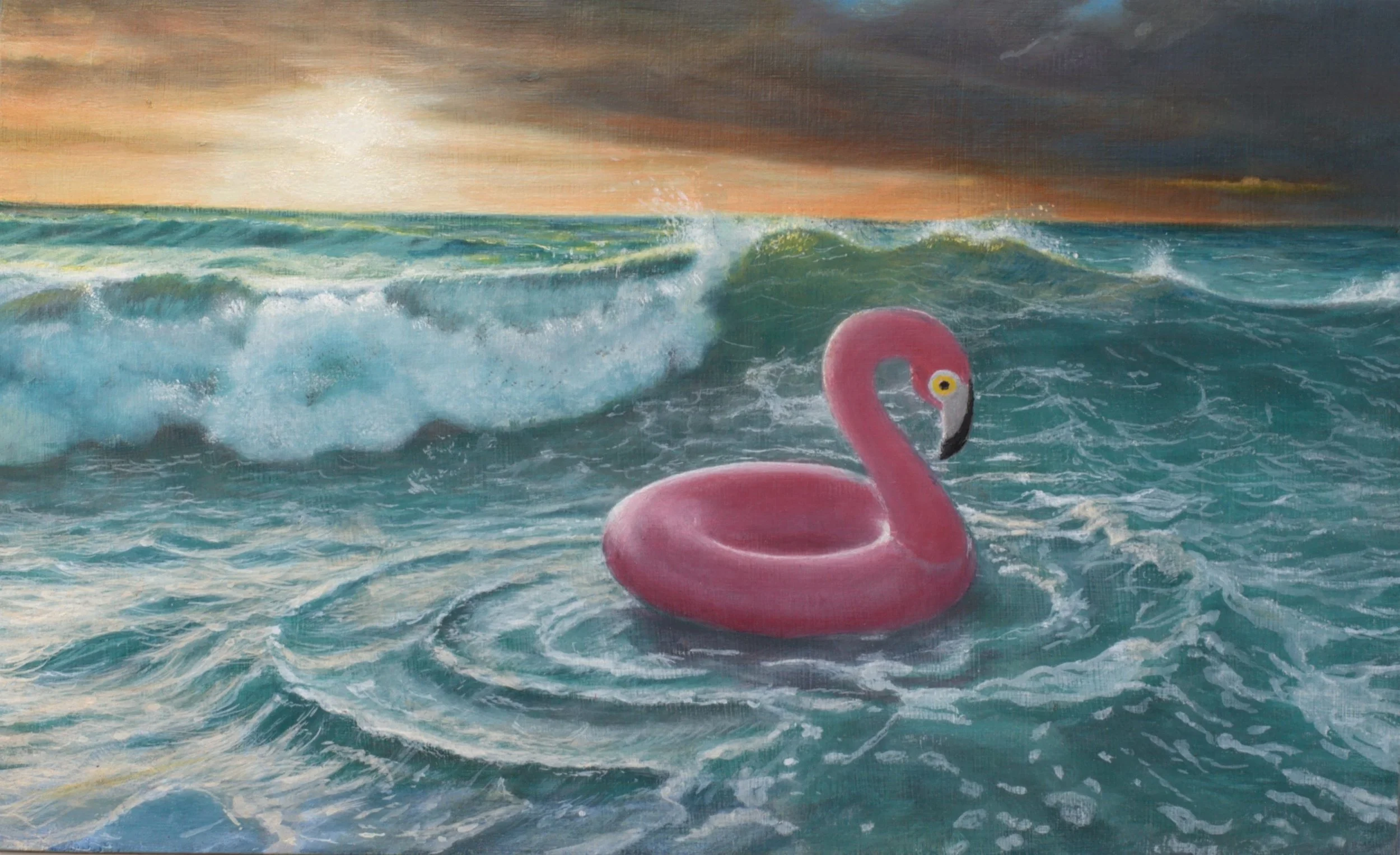
There is a particular quality of folly that the news cannot capture — the grand, collective kind, where societies march confidently toward the edge of something and call it progress. The Absurdist Series is Les Boonekamp's response to that spectacle. Set against the vast, indifferent theatre of the open ocean, each painting places the emblems of human vanity — rubber ducks, flamingos in swim rings, paper boats, dunce caps — into seascapes of genuine beauty and force. The contrast is not accidental. The series insists that satire and beauty are not opposites but allies, and that laughter, properly aimed, is among the more honest responses to the political and social theatre of our time.
The philosophical company here is Camus, Sartre, and Beckett — thinkers who understood that the absurd is not a retreat from seriousness but its sharpest form. Yet the paintings owe more to Magritte's wit than to existential dread. There is pleasure here — in the colour, in the light on water, in the absurd dignity of a flamingo adrift in the Southern Ocean — and that pleasure is part of the argument. A seagull moves through many of the works as a recurring figure: observer, guide, the one creature present who has always known exactly where it stands. The series grew from two decades of watching public life with the attention of a sculptor — someone trained to read weight, balance, and the precise moment a thing is about to fall.
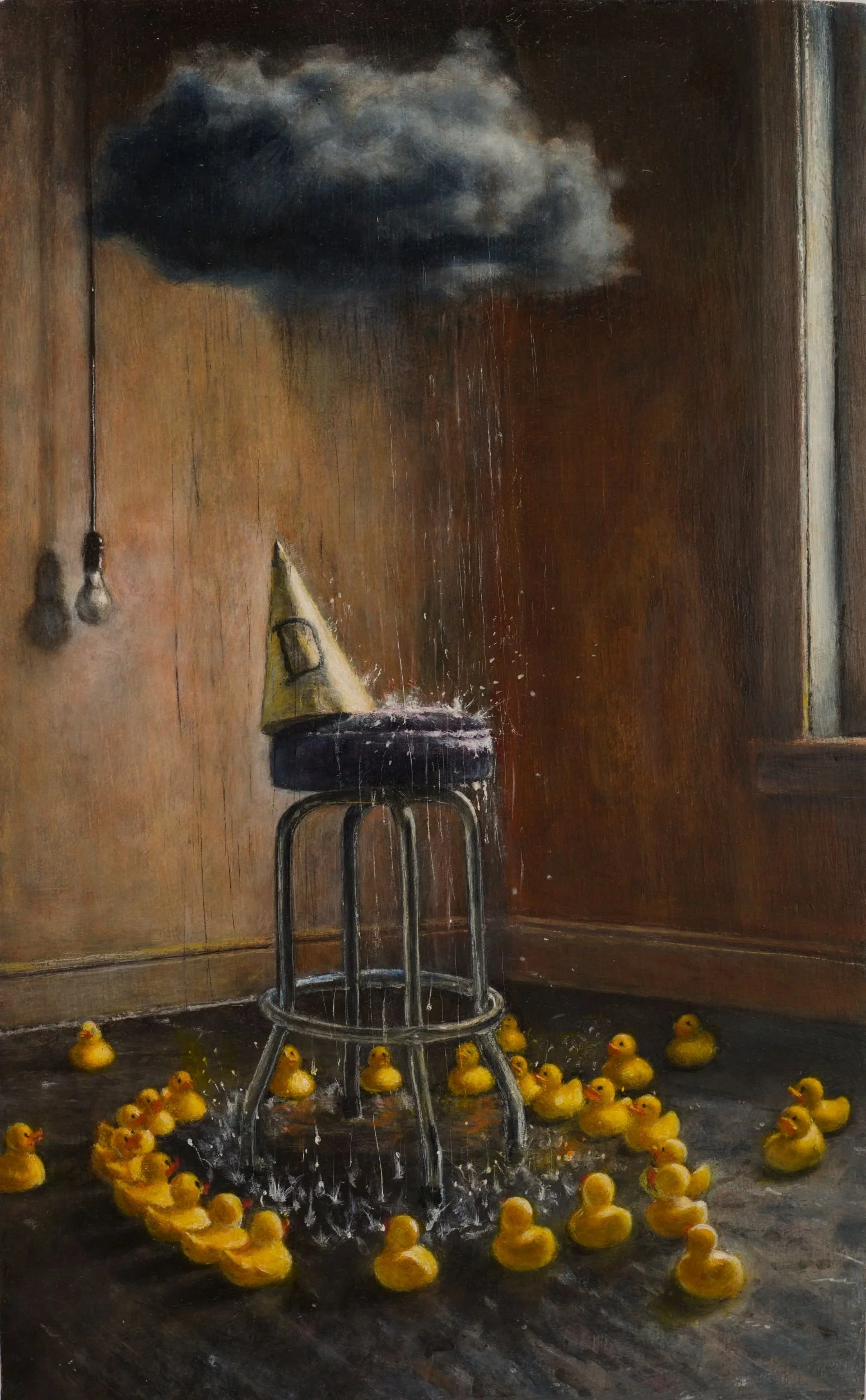
Dunce Hat 3
Oil and Egg Tempera on Marine Ply, 2026
32 cm × 19 cm
A corner of a room, previously wallpapered to the skirting. A bare bulb hangs unlit against the left wall. Above the centre of the room, a cloud has formed and is raining.
Beneath stands a stool. On the seat is a paper hat marked with a D. The seat is empty.
The floor has become wet. Water has gathered around the base of the stool, and in it and around it sit rubber ducks, arranged in a broken ring, facing inward.
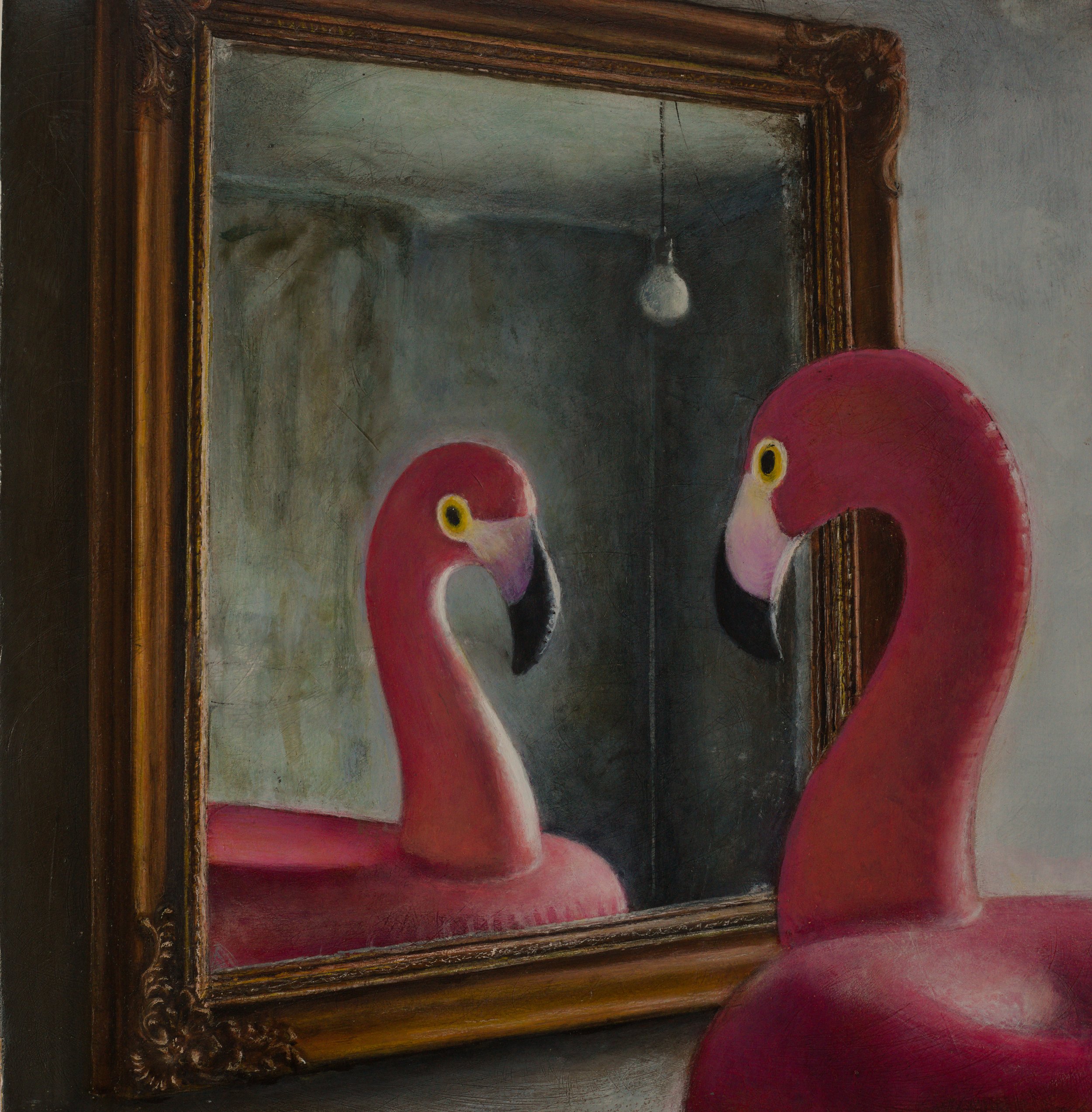
Company
Oil and egg tempera on marine ply, 2026
26.5 × 26 cm
A mirror in a gilt frame hangs on a pale wall. In the glass, the reflection of a room: a corner, a wall, a bulb on a flex.
An inflatable flamingo ring stands at the right edge of the picture, its head turned toward the mirror. Its reflection turns back. The two heads are close, almost at the same height, and do not touch.
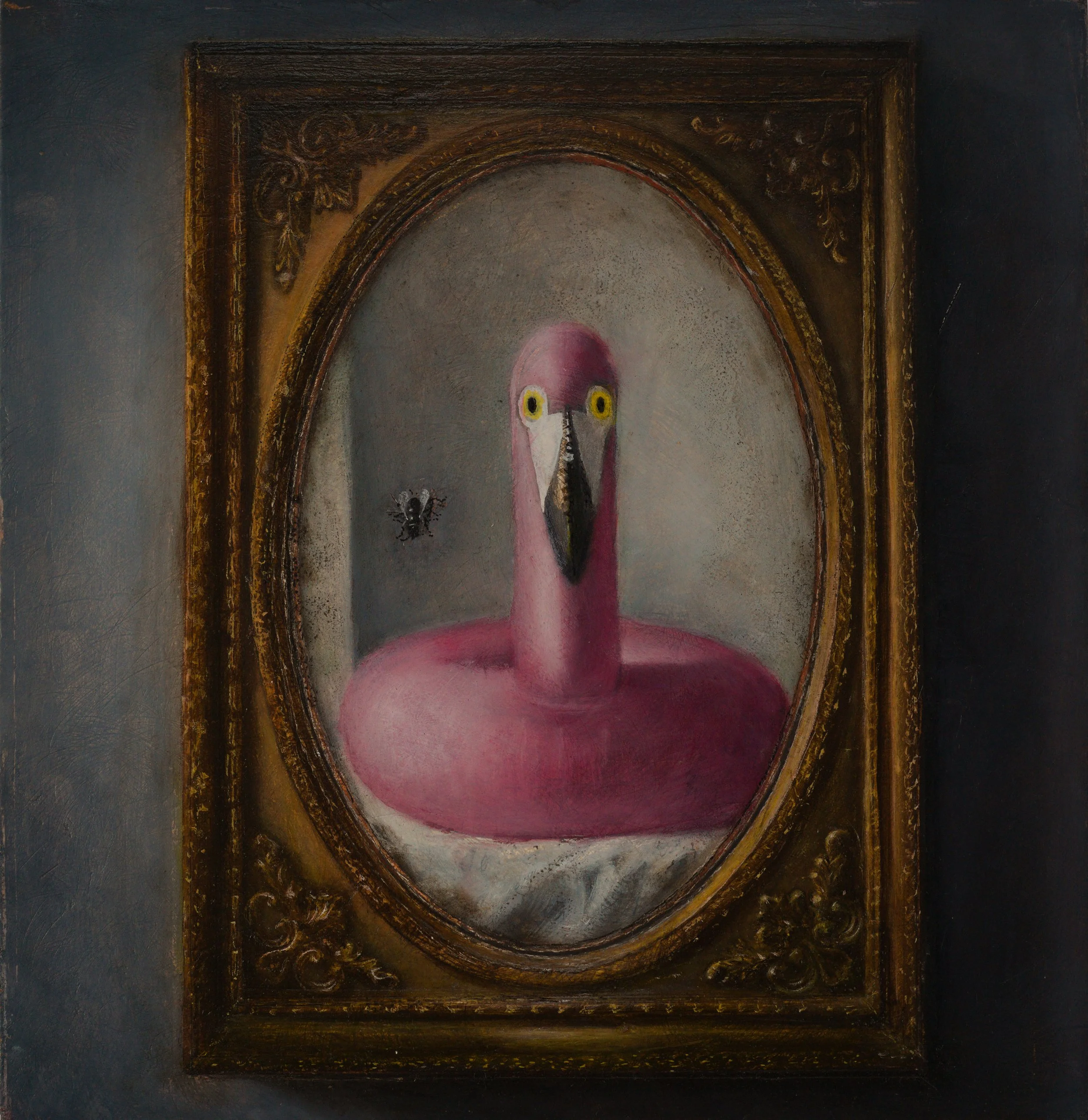
The Admirer
Oil and egg tempera on marine ply, 2026
26.5 × 26 cm
An oval mirror set in a gilt frame with carved corners. The flamingo ring faces directly out of the glass, filling the oval, its head level and its eyes forward.
On the surface of the glass, to the left of the head, a fly has settled.
Suit Yourself
Oil and egg tempera on marine ply, 2026
26.5 × 26 cm
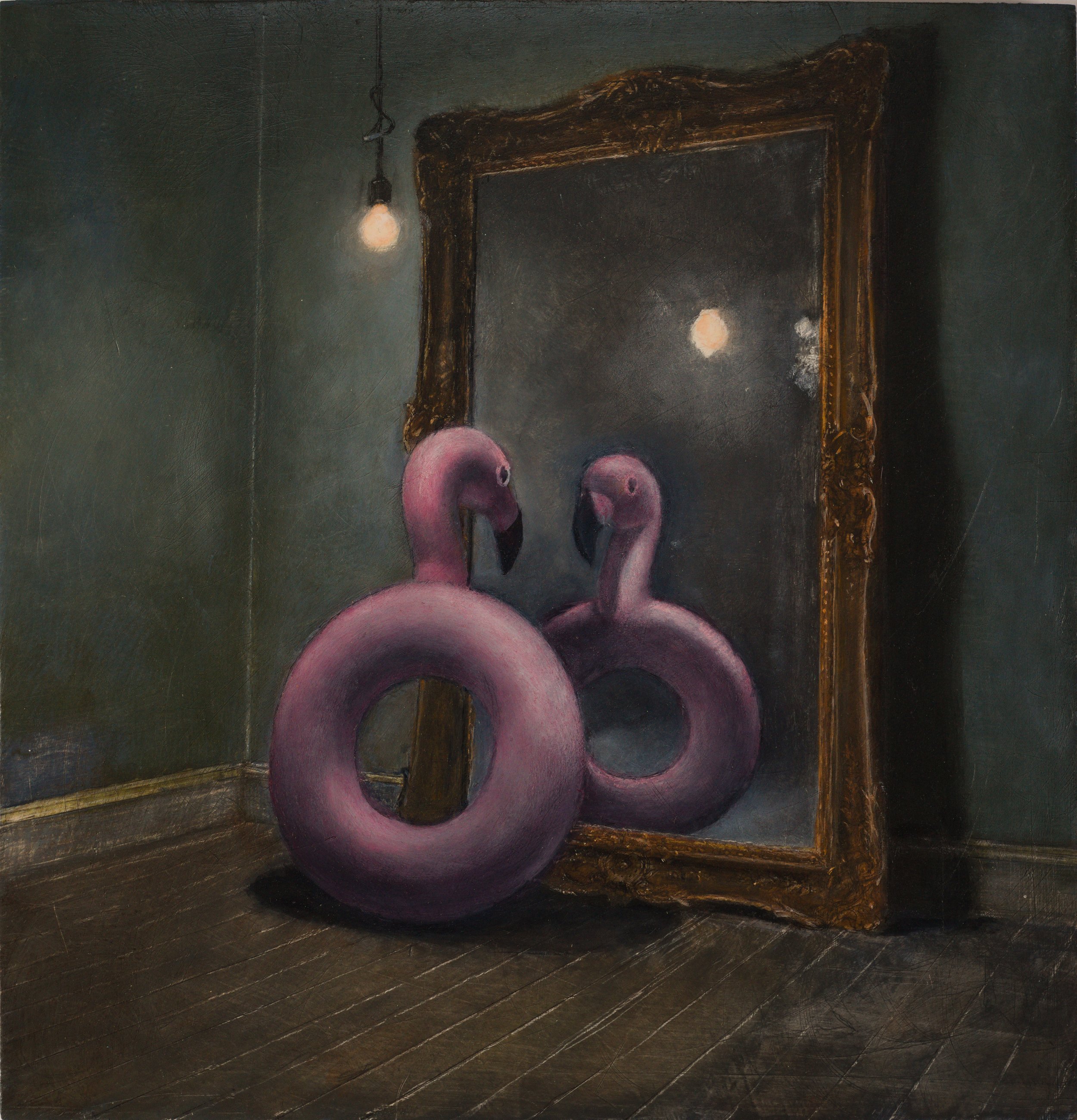
A room at night. Bare boards, a bare bulb, walls in shadow. A large mirror in a gilt frame leans against the wall, resting on the floor.
The flamingo ring sits on the boards in front of it, propped against the frame. Its head is lowered. In the glass, the reflection's head is lowered too.
Market Corrections 1
Oil and egg tempera on marine ply, 2026
19.5 × 32 cm
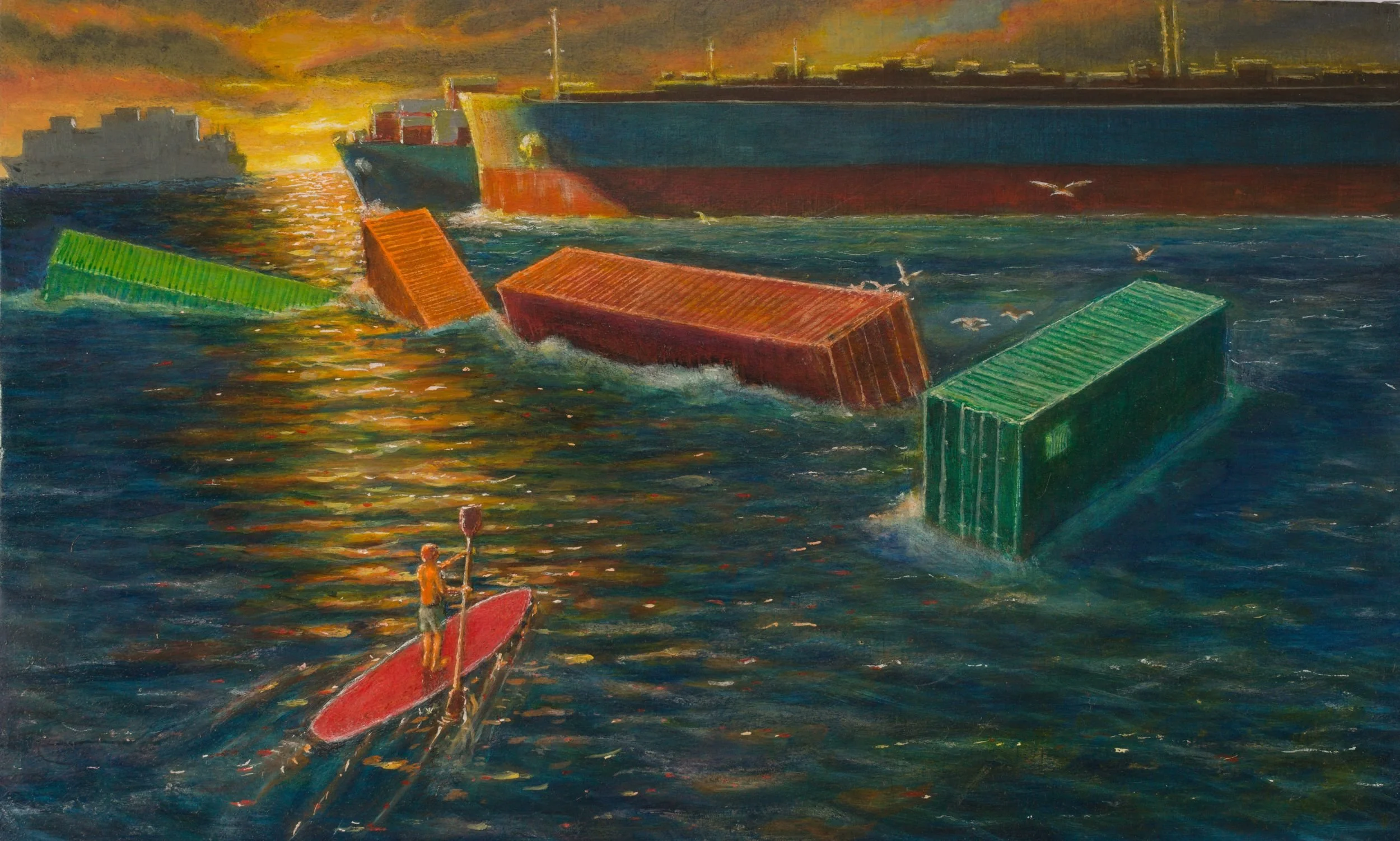
Open water at sunrise. A container ship lies across the horizon, and beyond it a shoreline of cranes and terminals against a lit sky.
Four shipping containers float in the foreground, tilted at different angles, low in the water. Gulls turn above them.
In the near water, a young man stands on a paddleboard with an oar, facing the containers. The light runs from the horizon down the water toward him.
Market Corrections 2
Oil and egg tempera on marine ply, 2026
19.5 × 32 cm
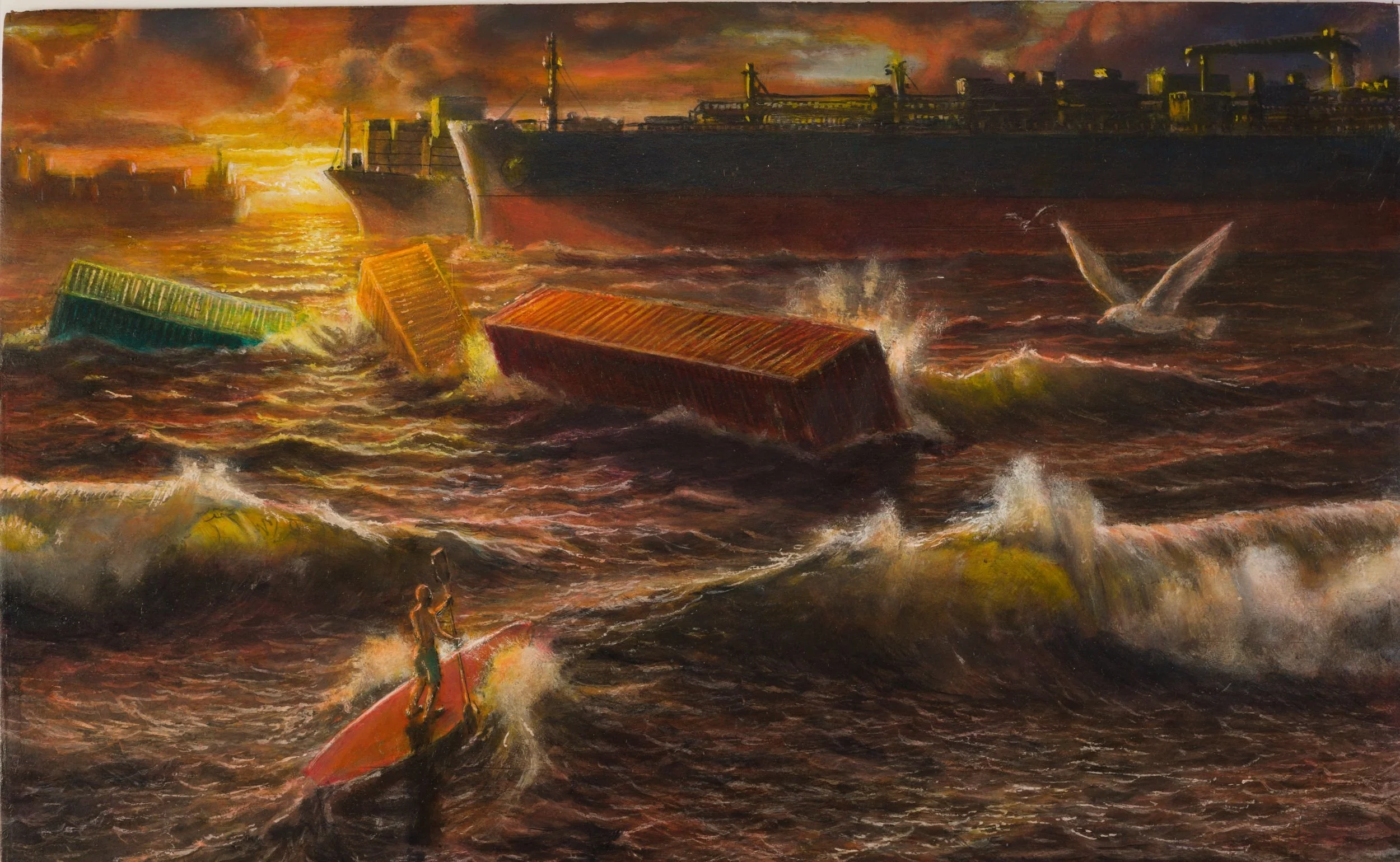
The same water at dusk, running heavy. A ship and a lit terminal along the horizon under a red sky.
Three containers float in the middle distance, one lifting on a wave. A gull crosses the right of the picture.
In the foreground, a wave is breaking. The young man stands on his board in the trough of it, oar raised.